Case Studies
A closer look at how I approach complex work, design solutions, and drive results across systems and teams.
Transformation of Enterprise Communications for a $8B+ Public Health Portfolio
Centers for Disease Control and Prevention
Summary
Led enterprise communications and workflow transformation for a high-volume public health environment.
Scope: $8B+ portfolio | 20,000+ personnel | 40+ divisions
Designed and implemented structured systems to improve clarity, coordination, and execution across complex, high-stakes operations.
The Challenge
The organization faced high volumes of communication requests, fragmented workflows, and limited visibility across teams. These challenges created inefficiencies, slowed execution, and made it difficult to maintain consistent, clear messaging across more than 40 divisions in a high-stakes public health environment.
Role
Communications and Operations Lead: Responsible for workflow design, executive communications, and cross-functional coordination across enterprise teams.
Approach
I approached this work by introducing structure and prioritization systems that could scale across a complex, high-volume environment.
-
Designed intake and prioritization systems to manage high-volume communication requests
-
Built workflows that improved coordination and accountability across teams
-
Partnered across 40+ divisions to align messaging and execution
-
Developed executive-level communications, including enterprise-wide messaging
-
Maintained readiness for time-sensitive and emergency communications
Results and Impact
-
Increased workflow efficiency by 40% within six months
-
Strengthened communication accuracy and consistency across teams
-
Supported over 30 emergency response efforts annually
-
Improved cross-functional alignment and visibility,enabling more consistent execution and stronger leadership insight
Key Learnings
This work reinforced that sustainable systems require both structure and shared understanding. Creating clarity at scale is about processes and ensuring people have the alignment and context needed to move work forward effectively.
Methods and Approaches
Workflow design | Intake and prioritization systems | Cross-functional alignment | Executive communications | Process improvement
Instructional Systems Transformation & AI Integration for Practical, Sustainable Use
Johnson-Walker Education Consulting (JWEC)
Summary
Designed and led instructional system transformation efforts focused on clarity, engagement, and sustainable implementation.
Focus Areas: Instructional systems | AI integration |
Educator development | Student engagement
Built and delivered frameworks and professional learning experiences that strengthened alignment between teaching practices and student outcomes across 50+ schools.
The Challenge
Educators and school leaders often face unclear instructional systems, inconsistent implementation, and limited time. Many existing approaches added complexity rather than improving clarity or outcomes.
Role
Founder and Principal Consultant: Responsible for designing frameworks, facilitating professional learning, and advising educators and leaders on instructional systems and strategy.
Approach
I approached this work by simplifying instructional complexity and building systems that are practical, adaptable, and sustainable.
-
Designed instructional frameworks (CPAEM, C.L.E.A.R.) to strengthen clarity in teaching and learning
-
Integrated literacy and socio-emotional learning into instructional design
-
Introduced AI as a practical tool for planning, feedback, and data use
-
Developed and facilitated professional learning for educators and leaders
-
Built tools and templates to support consistency and ease of implementation
Results and Impact
-
Drove measurable improvements in instructional clarity and student outcomes across partner schools
-
Drove 25%+ growth in GMAS math proficiency and 90% science proficiency achievement
-
Supported an 84% CCRPI math proficiency through aligned instructional systems
-
Partnered with 50+ schools across multiple states, extending impact across diverse learning environments
-
Strengthened teacher clarity and confidence, with 100% of administrators reporting improved instructional alignment
Key Learnings
Effective systems are those that can be sustained. The most impactful work balanced structure with flexibility, ensuring that educators could adapt tools and strategies to meet the needs of their students while maintaining clarity and purpose.
Methods and Approaches
Instructional frameworks (CPAEM, C.L.E.A.R.) | AI-supported planning and feedback | Data-informed instruction | Coaching and facilitation | Professional learning design

Strengthening Executive Communications and Program Positioning
Texas A&M at Galveston
Summary
Led strategic communications to strengthen executive alignment and program positioning within a higher education setting
Focus Areas: Executive communications | Strategic messaging | Stakeholder alignment
Translated complex program priorities, resource needs, and student impact into clear, actionable narratives that supported informed decision-making.
The Challenge
Program initiatives, resource needs, and student outcomes were not consistently communicated in a way that supported leadership alignment or external understanding. Complex information needed to be translated into clear, compelling narratives for both internal and external stakeholders.
Role
Communications and Strategy Lead: Led development of executive messaging, budget presentation materials, and stakeholder-facing communications.
Approach
I approached this work by translating complex program priorities into clear, structured narratives aligned with leadership decision-making.
-
Led development of executive-ready budget presentation materials and supporting communications
-
Synthesized program data, resource needs, and student impact into clear, actionable messaging
-
Aligned communications with institutional priorities and audience needs
-
Coordinated messaging across internal leadership and external stakeholders
Results and Impact
-
Led development of a strategic budget presentation resulting in a $100K increase in departmental funding
-
Strengthened clarity and consistency in how 20+ programs were communicated to 3,000+ stakeholders annually
-
Increased alignment and visibility of program impact and resource needs by 15%
Key Learnings
Clear communication is critical to effective decision-making. When information is structured and aligned with audience needs, it not only improves understanding but also strengthens trust and alignment across stakeholders.
Methods and Approaches
Executive communication | Strategic narrative development | Data synthesis | Stakeholder alignment | Decision support

Leading Community Engagement and Historical Recognition Efforts
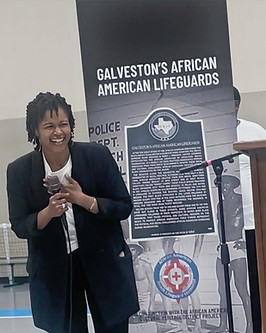
African American Beach Lifeguarding Project
Summary
Led communications and stakeholder engagement for a community-centered historical recognition initiative.
Focus Areas: Stakeholder engagement | Community-centered leadership | Strategic alignment | Partnership development
Drove alignment across community voices and institutional partners to support a statewide effort preserving and elevating an underrepresented history.
The Challenge
The contributions of Black lifeguards in Galveston had been historically underrecognized. The initiative required coordination across community members, historians, and institutional partners while ensuring the work remained aligned with community voice and historical accuracy.
Role
Communications and Engagement Lead:
Responsible for stakeholder coordination, communications strategy, and event planning.
Approach
I approached this work with a focus on trust, alignment, and community-centered decision-making.
-
Led communications strategy to reflect the significance and integrity of the project
-
Coordinated engagement across community members, historians, and institutional partners
-
Supported planning and execution of public-facing events and recognition efforts
-
Aligned messaging with both community priorities and institutional expectations
Results and Impact
-
Supported the development of a state-recognized historical marker in partnership with the Texas Historical Commission
-
Increased public awareness and visibility of an underrepresented historical narrative
-
Strengthened engagement and alignment across diverse community and institutional stakeholders
-
Established a lasting form of community recognition and historical preservation
Key Learnings
Sustainable community impact requires trust, intentional engagement, and a commitment to honoring the voices and perspectives of those most closely connected to the work.
Methods and Approaches
Stakeholder engagement | Community-centered leadership | Partnership development | Strategic communication |
Event strategy